Black Friday and Cyber Monday are still treated like dates on a marketing calendar. Offers are finalized, budgets increase, creators are activated, and teams prepare for a few days of intense promotional activity. But that way of thinking misses what actually determines performance during the holiday season.
The discount may happen in November, but the conditions that make it convert are created much earlier.
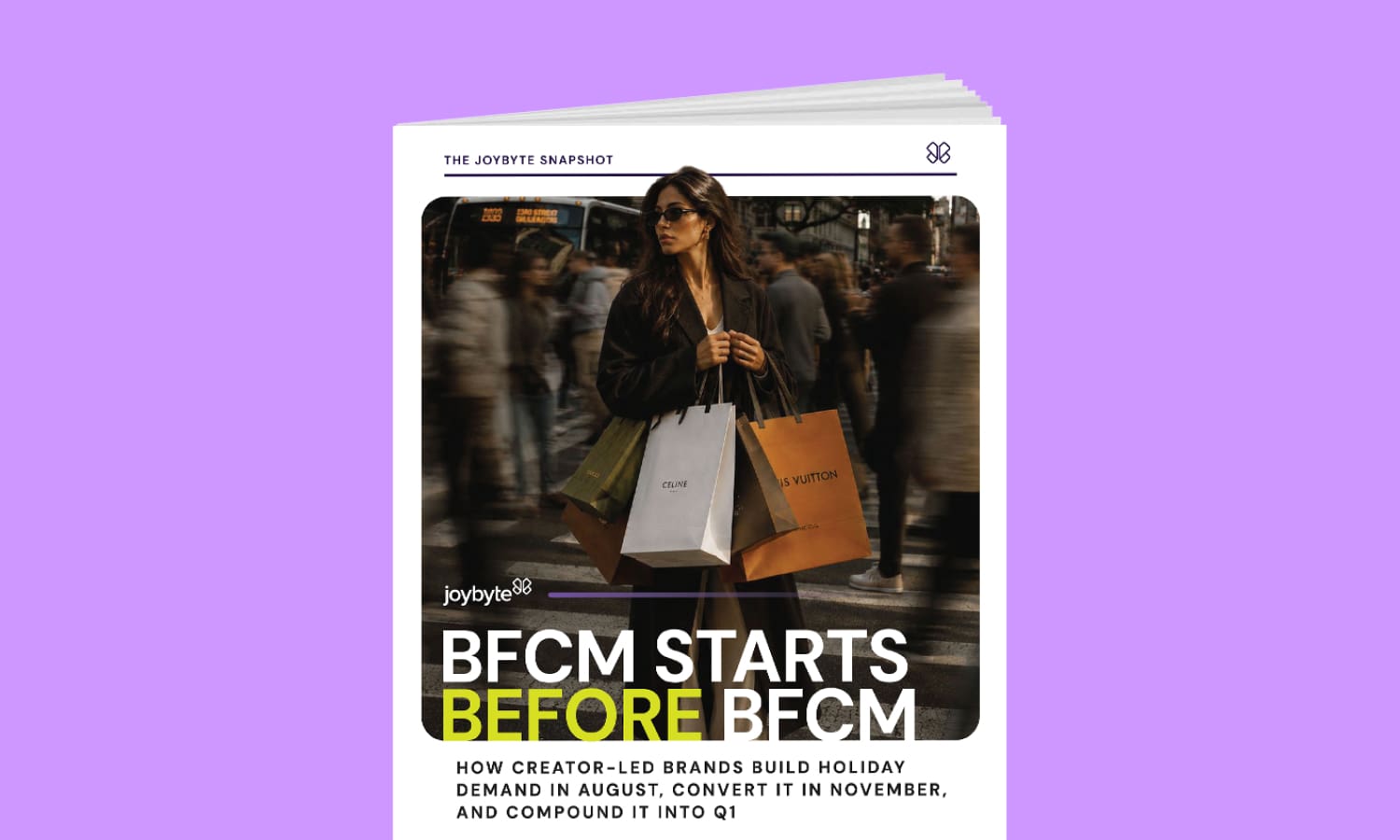
That’s the central argument behind Joybyte’s new white paper, BFCM Starts Before BFCM. The brands best positioned to win during the holiday period aren’t simply the ones with the strongest offer or largest media budget. They’re the ones that have already built familiarity, trust, creator participation, creative evidence, platform readiness, and audience anticipation before competition reaches its peak.
That requires treating BFCM as something bigger than a promotion. It requires treating it as a four-month demand system.
From a Promotional Calendar to a Demand System
Joybyte’s framework breaks that system into four connected stages: PRIME → PROVE → PEAK → PERSIST.
PRIME begins in August and September, when brands have the space to build creator relationships, establish product familiarity, introduce different narratives, and prepare TikTok Shop operationally. PROVE follows in October and early November, when the focus shifts toward understanding which creators, hooks, products, offers, and content are actually generating meaningful audience response.
PEAK is the BFCM period itself. By this point, the objective should no longer be discovery. Creators, organic social, TikTok Shop, promotional offers, and paid media should come together around demand signals that have already been validated. Then comes PERSIST, when the promotion ends but the system continues. Winning creators, content, products, and learnings are carried into December and Q1 instead of disappearing with the holiday campaign.
The important distinction is that these stages aren’t separate campaigns. Each one makes the next more effective. The relationship built in August creates more credible content in September. That content generates signals in October. Those signals tell the brand what deserves investment in November. And November’s performance creates the evidence that should shape Q1.
Creators Have More Value Before the Sale
One of the biggest shifts in this model is the role creators play before peak season.
When brands wait until November to activate creators, the relationship is inherently transactional. The creator receives a product or brief, publishes promotional content, and asks an audience to act almost immediately. There is very little time for genuine product experience, repetition, audience feedback, or learning.
Starting earlier creates a different dynamic. Creators can actually use the product and determine how it fits naturally into their lives and content. Their audiences can encounter the brand without every interaction being tied to a promotion. Questions and objections begin surfacing. Certain use cases resonate more than others. Some creators establish credibility around the product while others reveal that the fit isn’t there.
All of that information has value before a single BFCM dollar is spent.
This is why creators should be viewed as the input layer of the holiday system rather than simply another distribution channel. They help brands understand what the market believes before the brand tries to scale that belief.
October Should Turn Content Into Evidence
By October, the question changes. The goal isn’t simply to produce more holiday content. It’s to determine what the content produced so far has taught you.
Which creator makes the product feel most credible? Which opening hook consistently earns attention? Which use case gets people asking questions? Which objection keeps appearing in the comments? Which product is emerging as the natural hero SKU? Which piece of creator content has demonstrated enough response to justify paid amplification?
Those are far more valuable questions than, “What should our Black Friday ad say?”
Brands may not need significant direct BFCM messaging during this period at all. Instead, October can be used to build a deeper library of product education, demonstrations, real-use experiences, objection handlers, audience questions, and creator narratives. By the time the promotion arrives, the brand isn’t starting with a blank creative brief. It has evidence.
That also makes content usage rights an important part of early creator planning. If a creator produces an asset that demonstrates strong audience response, brands need enough time to secure the appropriate permissions, prepare the creative, and make it available for amplification before peak media pressure arrives.
TikTok Shop Changes What “Ready” Means
Creative readiness is only one part of the system. TikTok Shop introduces another layer because holiday visibility and conversion depend on operational readiness as well.
A brand planning to use TikTok Shop meaningfully during the holiday period needs more than products uploaded to a storefront. The shop needs time to establish operational health, fulfillment performance, creator activity, affiliate participation, competitive offers, inventory, and eligibility for platform campaigns.
This matters because Black Friday and Cyber Monday are major promotional periods within TikTok Shop’s ecosystem. Opportunities for additional merchandising and discovery can depend on factors such as account health, cancellation rates, fulfillment performance, product quality, inventory, and participation in eligible platform programs.
The implication is important: TikTok Shop readiness is part of the marketing strategy. A strong creator program can create demand, but the commerce infrastructure has to be capable of capturing it. If the shop is still navigating setup or its cold-start phase when November arrives, the brand is using its most valuable selling window to build infrastructure that should already exist.
Peak Season Requires Coordination, Not More Noise
When BFCM finally arrives, almost every brand has access to the same promotional vocabulary. Biggest sale. Lowest price. Limited time. Ends soon.
The problem isn’t a lack of promotional messaging. It’s an abundance of it.
That means every part of the system needs a distinct job. Affiliates can produce offer-forward demonstrations and convert demand through shoppable content. Higher-trust creator partners can remind audiences of experiences and narratives established earlier in the season. LIVE hosts can answer questions and create real-time urgency. TikTok Shop can capture transactions natively. Paid media can increase distribution behind content that has already demonstrated strong behavior.
Organic social has a particularly important role because it has to make the promotional moment worth paying attention to. Instead of repeating the discount, brands can create participation around it through audience-powered deal unlocks, creator challenges, real-time behind-the-scenes content, personalized video responses, product debates, and post-purchase activations.
The offer remains important, but the content surrounding the offer creates the reason to keep watching.
Paid Media Should Arrive With an Answer
One of the most expensive mistakes brands can make during BFCM is using paid media to discover their creative strategy.
By peak season, paid should already have an answer to the question: “What has earned the right to scale?”
Creator and organic activity provide the evidence. Watch time can reveal which hooks hold attention. Comments can expose interest and objections. Saves and clicks can indicate intent. Add-to-cart activity and organic conversions can show which content is moving people closer to purchase.
Paid media then has a very specific role: increase the distribution of proven behavior.
This reverses the traditional process of developing a campaign message internally and then spending money to determine whether consumers respond to it. The market gets a vote earlier. Creators generate the signals, audiences respond, and paid investment follows the evidence.
The Real Output of BFCM Is More Than Revenue
Revenue is obviously a critical measure during Black Friday and Cyber Monday, but a creator-led system should produce something else at the same time: learning.
The holiday period reveals which language creates action, which creators build trust, which formats hold attention, which product combinations make sense, which objections prevent conversion, and which assets remain useful beyond a single promotional window.
That means performance should be evaluated across several dimensions. Attention tells the brand what earns interest. Intent reveals movement toward purchase. Trust shows whether creators and messaging are creating confidence. Commerce measures the transaction itself. Learning identifies what the organization now knows that it didn’t know before. Durability shows what can continue producing value after the event.
A strong BFCM program should therefore improve more than the November P&L. It should improve the brand’s next decision.
Cyber Monday Should Trigger Reallocation, Not a Reset
The final stage of the system may be the most overlooked.
Once the promotion ends, brands have a concentrated body of evidence about their creators, content, products, customers, and offers. Too often, that intelligence gets turned into a recap deck while the creator and content engines slow down.
The white paper proposes a different response: classify what happened quickly and reallocate accordingly. Creators and content that generated meaningful attention, trust, or conversion should be scaled. Partners with strong audience fit but incomplete messaging can be developed. Concepts that produced neither commercial results nor useful learning can be retired.
The narrative should evolve as well. Holiday urgency can become January routines, resolutions, replenishment, education, product longevity, and everyday utility. Creator-vetted assets can continue across paid social, organic channels, product pages, and future briefs where usage rights allow. TikTok Shop recruitment and affiliate management can continue instead of collapsing after the seasonal spike.
Most importantly, the creator relationships built before BFCM don’t have to end with it. Strong partners can become the foundation of an always-on program, allowing the brand to enter Q1 with existing trust and system memory instead of rebuilding from zero.
Peak Performance Is Built Before the Peak
The larger lesson isn’t simply that brands should “start BFCM earlier.” It’s that the holiday season works differently when every stage is connected.
Creators generate demand and reveal what audiences respond to. Organic social reinforces those signals and keeps the brand culturally present. TikTok Shop captures and validates demand. Paid media amplifies what has already proven itself. Operations protect the experience when demand converts. And the learnings from the entire system inform what happens next.
That’s the difference between running a Black Friday campaign and building a BFCM growth system.
Start in August. Learn in September. Prove in October. Convert in November. Compound into Q1.
Download our new white paper, BFCM Starts Before BFCM, to explore the full framework and build your holiday strategy around what works before the peak arrives.