For decades, marketing has followed a familiar sequence: research the audience, develop the strategy, write the brief, build the creative, then bring creators in to help distribute the idea.
There’s just one problem. By the time creators enter the process, some of the most important decisions have already been made. The audience has been defined. The message has been chosen. The creative territory has been established. And the brand has already decided what people are supposed to care about.
That model made more sense when brands controlled most of the ways ideas reached the market. Social changed that. Today, audiences are constantly showing us what they notice, ignore, question, repeat, buy, and believe. Creators sit directly inside those behaviors, with a front-row seat to culture and community response in real time.
Which raises a bigger question: Why are we waiting until after the brief to listen to them?
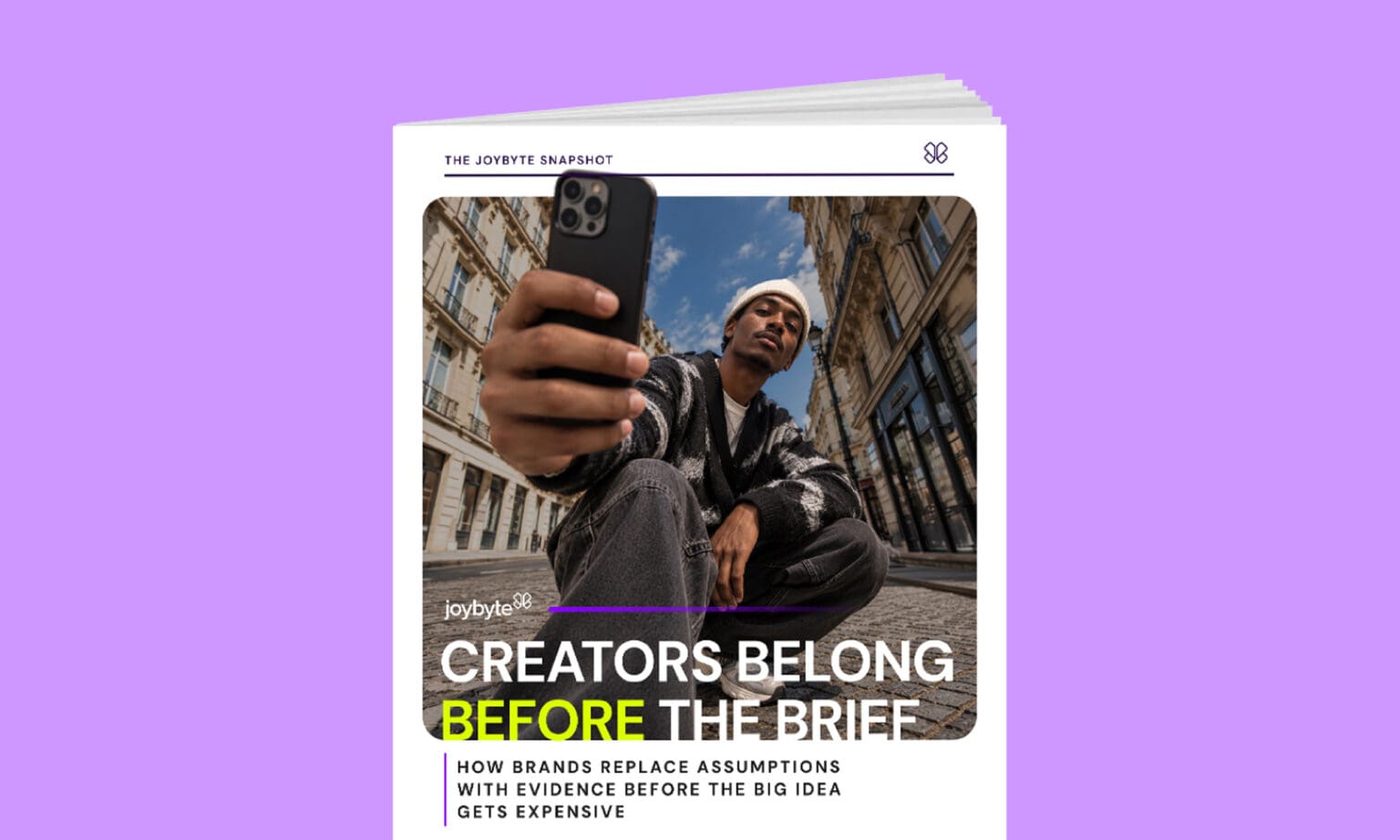
That question is at the center of Joybyte’s new white paper, Creators Belong Before the Brief: How brands replace assumptions with evidence before the big idea gets expensive.
The Traditional Creative Process Has an Input Problem
Every brief begins with assumptions. That doesn’t mean the strategy is bad. It means there is a structural limitation to any process that begins primarily inside the organization. No strategist, creative director, marketer, agency, or research team can perfectly represent every community a brand hopes to reach.
We can research those audiences, analyze them, and build personas around them. But increasingly, we can also observe how they behave in the real world. That is where creators change the equation.
Their value isn’t limited to the audiences they can reach. It also comes from their proximity to the people, behaviors, conversations, language, and cultural signals brands are trying to understand. When that intelligence enters the process earlier, it can challenge assumptions before those assumptions become expensive creative decisions.
What Changes When Creators Move Upstream?
Most creator marketing still asks some version of: How do we get creators to make people care about this? But that question assumes the brand has already figured out what people should care about.
A creator-led system asks something different: What are creators seeing that we’re not?
That shift sounds subtle, but operationally, it changes a lot. Creators stop being treated only as the last mile of creative execution and begin functioning as an early source of creative intelligence. Instead of simply distributing the answer, they can help brands discover it.
Our new Snapshot explores what that looks like in practice, including what creators can reveal about audiences, positioning, language, use cases, objections, and creative direction before a brand commits to scale.
The Brief Doesn’t Go Away. It Gets Smarter.
This isn’t an argument against strategy, creative teams, or briefs. It’s an argument for giving them better inputs. The strongest creative organizations won’t eliminate the brief; they’ll stop treating it as the moment when learning ends.
The market keeps talking after the strategy deck is approved. Creators generate signals. Audiences respond. Unexpected behaviors emerge. Certain ideas travel while others disappear. Some assumptions strengthen, while others fall apart.
The opportunity is to build those signals back into the creative process rather than allowing every new campaign to begin from scratch. That’s when creator marketing stops functioning like a collection of disconnected campaigns and starts becoming a learning system.
And the implications extend far beyond social.
The Brands That Learn Fastest Will Have the Advantage
The next era of creator marketing isn’t about putting more creators into media plans. It’s about changing where creators sit in the growth system.
When creator intelligence enters earlier, brands have an opportunity to learn before they scale. Real market response can begin informing the ideas, language, creative territories, and investments that come next. Over time, that learning can influence much more than creator content, shaping paid media, commerce, brand creative, search, product pages, retail, and even product decisions.
But getting there requires a different operating model.
Creators Belong Before the Brief explores that model: why the traditional sequence is breaking down, what creators can reveal before the big idea gets expensive, how creator signals can strengthen the brief, and what changes when brands build learning into the system from the beginning.
The shift is simple: from assumptions to evidence, from planning to learning, and from creators after the brief to creators before it.
Creators Don’t Replace the Big Idea. They Help Us Find the One Worth Making Big.
The opportunity isn’t to hand strategy over to creators. It’s to stop leaving one of the richest sources of audience intelligence out of the room until the most important decisions have already been made.
Download our Snapshot: Creators Belong Before the Brief to explore the full framework, real-world examples, and a new approach to bringing creator intelligence upstream—before the big idea gets expensive.