Marketers are obsessed with what’s next. The next aesthetic, viral product, creator format, platform behavior, or cultural moment that brands need to understand before everyone else does.
But there’s a problem with the way we tend to study trends: we spend so much time watching what’s emerging that we rarely examine what happens after a trend peaks.
That’s a missed opportunity. Dead trends leave evidence behind. Once a cultural moment has run its course, we can see more clearly why people participated, what accelerated its growth, what eventually made it feel tired, and—most importantly—what consumers carried with them when they moved on.
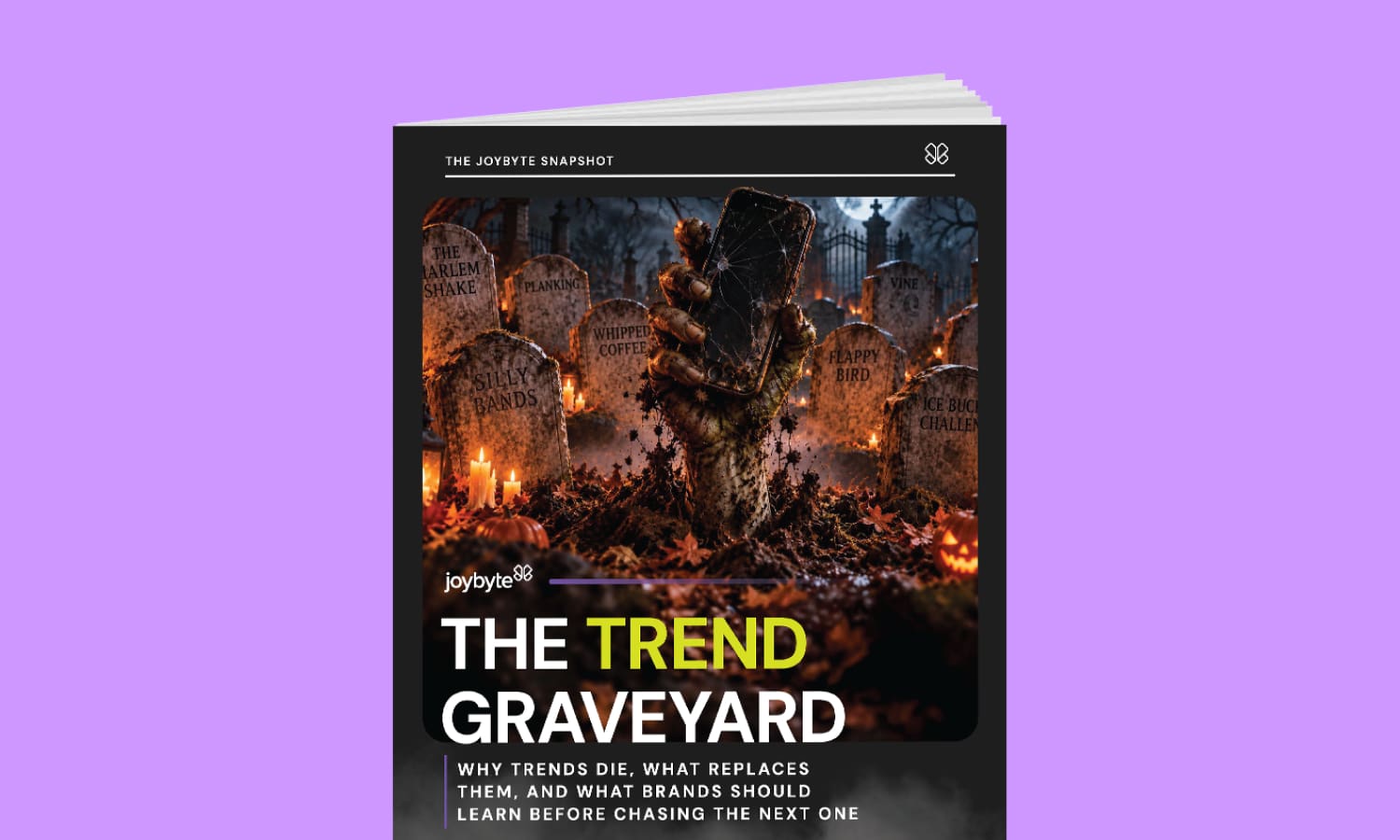
That idea is at the center of Joybyte’s new Snapshot, The Trend Graveyard: Why trends die, what replaces them, and what brands should learn before chasing the next one.
Trends Die. The Need Behind Them Doesn’t.
Think about some of the defining trends of the last several years. VSCO Girl disappeared from the cultural conversation. Cottagecore faded from its pandemic-era peak. Whipped Coffee stopped dominating feeds. BeReal declined from its height. Tiny Luxury Bags stopped feeling quite so novel.
It would be easy to look at each example and conclude that consumers simply lost interest. But that misses what was actually happening.
People didn’t suddenly stop wanting belonging when VSCO Girl faded. They didn’t stop wanting escape when Cottagecore lost momentum. The appetite for participation didn’t disappear with Whipped Coffee, just as the desire for authentic connection didn’t disappear with BeReal. Status and self-expression certainly didn’t vanish when fashion moved beyond the tiny-bag moment.
What changed was the expression of the need, not necessarily the need itself.
That distinction should fundamentally change how brands think about trends. Instead of asking only, “How do we participate in what’s popular right now?” marketers should be asking a more useful question: What is this behavior telling us people want?
Because the answer to that question can remain valuable long after the trend itself is gone.
When a Trend Gets Big Enough, the Rules Change
There’s an inherent contradiction in trend culture: the same forces that make something successful can eventually make it less desirable.
Trends often begin with novelty, distinction, or participation in something that still feels culturally specific. As creators accelerate adoption and platforms distribute the behavior to larger audiences, that changes. More people recognize it, more people reproduce it, and eventually brands and mainstream culture arrive.
At some point, recognizability becomes predictability. What once communicated distinction starts communicating sameness.
This creates a particularly difficult timing problem for marketers. By the time a trend is obvious enough to appear in every brand brainstorm, the cultural energy that created it may already be shifting somewhere else.
That doesn’t mean brands should ignore trends. It means copying what is visible is a very different capability from understanding why it became visible in the first place.
Our new Snapshot examines that distinction through five trends that followed very different trajectories but reveal a surprisingly consistent pattern about how cultural behaviors emerge, scale, saturate, and eventually get replaced.
The Better Opportunity Is Learning to Read the Signal
This is also where trend intelligence becomes much bigger than trend reporting.
Brands don’t need to perfectly predict the next viral phenomenon. They need a system capable of recognizing meaningful signals early enough to learn from them.
Creators are an important part of that system because they don’t simply participate in culture after it has been defined. Collectively, they give brands a way to observe behavior as it develops: the language audiences begin repeating, the questions that keep appearing, unexpected product use cases, emerging rituals, frustrations that become jokes, and behaviors beginning to travel from niche communities into broader adoption.
That connects directly to a larger principle behind Joybyte’s creator-led approach: creators are most valuable before scale because creator activity can reveal which concepts resonate, which language feels credible, which visuals make an idea click, and which formats audiences actually respond to. Those signals give brands evidence they can use before committing larger creative and media investment.
In other words, creators aren’t only a way to participate in trends. They can help brands understand why culture is moving in the first place.
Stop Trying to Predict Culture. Build a System That Learns From It.
The brands with the strongest cultural intelligence won’t necessarily be the ones with the best trend forecasts. They’ll be the ones continuously observing creators and communities, testing different expressions, identifying recurring signals, and carrying those learnings into creative, paid media, commerce, product, and the next creator brief.
That creates something far more valuable than being early to one trend: system memory.
Every cultural cycle becomes an input into the next one. Every creator relationship can generate information as well as content. Every audience response can sharpen the brand’s understanding of what people care about and why. Instead of starting from zero every time culture shifts, the organization gets smarter with every cycle.
That is the bigger opportunity behind The Trend Graveyard. This isn’t a list of trends we think are “dead,” nor is it a prediction of exactly what will replace them. It’s a framework for understanding what trends reveal about human behavior—and how brands can build a better system for recognizing where those behaviors might show up next.
Inside the full Snapshot, we break down the rise and decline of VSCO Girl, Cottagecore, Whipped Coffee, BeReal, and Tiny Luxury Bags, introduce Joybyte’s Replacement Effect, explore the forces that push trends toward saturation, examine current cultural behaviors worth watching, and share a practical framework brands can use to decode emerging signals before deciding whether to participate.
Because the graveyard is full of old expressions. The needs that created them are still very much alive. Download the full report to learn how to stop chasing what culture already did—and start building a system that helps you see where it’s going.