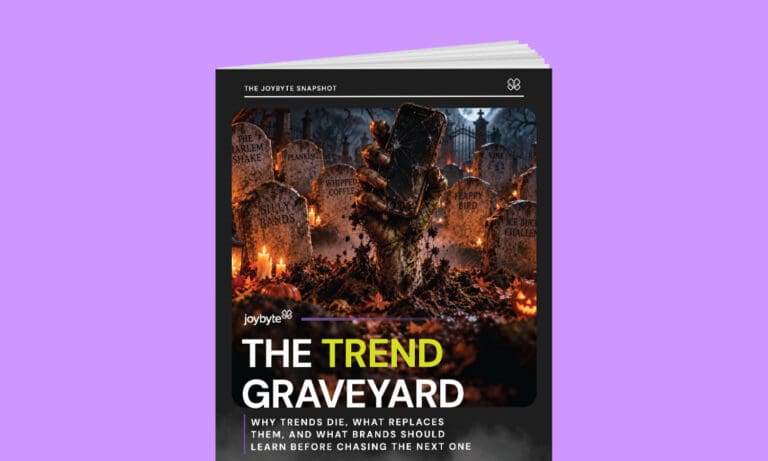
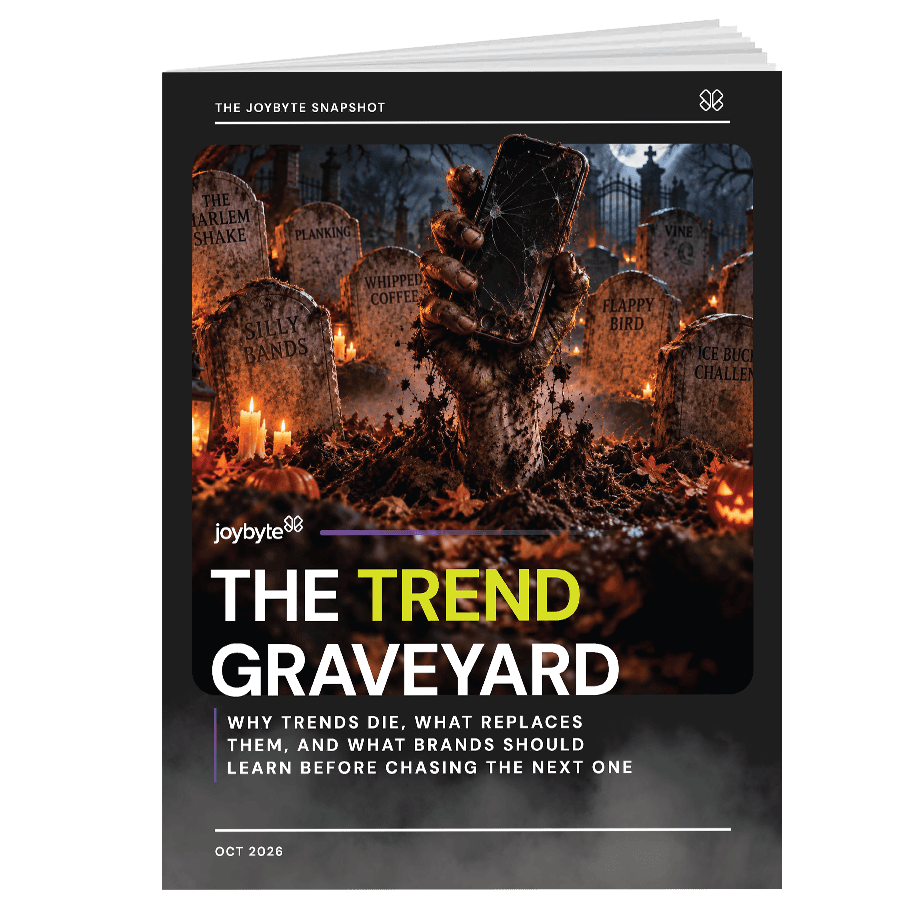
The Trend Graveyard
Why trends die, what replaces them, and what brands should learn before chasing the next one.
Every trend eventually dies. But the desire that made it matter usually doesn’t.
VSCO Girl disappeared. The need for belonging didn’t. Cottagecore faded. The desire for escape didn’t. BeReal lost momentum. The appetite for authentic connection didn’t disappear.
Joybyte’s new Snapshot explores The Replacement Effect: why cultural expressions get saturated and replaced while the human motivations underneath them persist—and how brands can use creator signals to understand where those needs are moving next.


Key Insights From the Snapshot
 Why trends die even when the consumer desire behind them remainsThe Replacement Effect: Human Need → Cultural Expression → Adoption → Saturation → ReplacementWhat VSCO Girl, Cottagecore, Whipped Coffee, BeReal, and Tiny Luxury Bags reveal about cultural cyclesWhy success and mass adoption can actually accelerate a trend’s declineHow oversaturation, commercialization, and recognizability turn cultural currency into clichéWhy creators function as an early-warning system for changing consumer behaviorHow to distinguish an isolated viral moment from a meaningful cultural signalThe six-step Trend Decoding FrameworkWhy brands should stop trying to predict the next trend and start following the underlying needHow creator-led learning builds cultural intelligence that compounds over time
By the Time Everyone Calls It a Trend, the Signal May Already Be Moving in the Room
Brands tend to react to what they can see. The aesthetic. The phrase. The product. The format. The viral behavior.
But those are expressions—not explanations. A trend becomes valuable strategically when you can understand why people wanted to participate in the first place.
Was it belonging? Escape? Status? Connection? Control? Participation? Because when the expression gets oversaturated, the need doesn’t disappear. It starts looking for somewhere new to go.
The brands that understand the need can follow culture forward. The brands that copy the expression arrive at the graveyard.

What You’ll Learn
 Why Trends Actually DieThe Need Underneath the TrendHow the Replacement Effect WorksWhy Creators Are an Early-Warning SystemHow to Decode a Trend Before Joining ItWhy Trend Prediction Is the Wrong Goal
VSCO Girl Didn’t Kill Belonging
The uniform changed. The need to signal membership didn’t.
Cottagecore Was Doing an Emotional Job
The aesthetic surged when escape and simplicity were especially valuable. As the cultural context changed, so did the expression.
Participation Has a Novelty Problem
Whipped coffee worked because millions of people could participate in the same recognizable ritual. Once participation became commonplace, its cultural currency declined.
Authenticity Can Become a Formula
BeReal demonstrated demand for casual, less-curated social connection—but even spontaneity can become performative once the format becomes familiar.
Status Always Finds Another Symbol
Tiny luxury bags faded as a dominant fashion expression. Status and self-expression did not.
Success Can Kill the Thing That Made a Trend Valuable
Discovery creates distinction. Scale creates recognizability. Too much recognizability creates sameness.
Creators Tell You What’s Moving Before the Deck Does
The real strategic advantage isn’t trend participation. It’s continuously observing creators and communities for emerging signals.
System Memory Beats Trend Chasing
A brand that chases every new trend repeatedly starts from zero. A creator-led learning system gets smarter with every cultural cycle. That idea is explicit in The Trend Graveyard and connects cleanly to Joybyte’s broader principle that continuous creator activity generates reusable learning rather than isolated campaign results.
Stop Chasing Trends. Start Reading Signals.
FAQs
Is The Trend Graveyard a trend forecast?
No. That’s intentionally not the point.
The Snapshot argues that predicting the exact next viral phenomenon is less useful than understanding the human motivation behind an existing trend and monitoring where that motivation begins appearing next.
What is the Replacement Effect?
The Replacement Effect describes what happens when a cultural expression becomes oversaturated, overly commercialized, easy to imitate, or disconnected from the moment that created it.
The expression declines—but the underlying motivation often migrates into a new product, aesthetic, behavior, platform, or symbol.
How can a brand tell when a trend is becoming saturated?
Look for signals such as formulaic repetition, widespread brand participation, parody, easy imitation, declining distinction, and recognizability becoming cliché.
Does this mean brands shouldn’t participate in trends?
No. It means participation should come from understanding rather than imitation.
The better question isn’t simply, “Can our brand do this trend?” It’s “What is this behavior telling us people want, and does our brand have a credible role in that need?”
What role do creators play?
Creators function as cultural sensors.
At sufficient scale and consistency, creator activity can reveal repeating language, emerging use cases, audience questions, changing aesthetics, new rituals, objections, product combinations, and behaviors moving from niche communities toward broader adoption.
What trends does the Snapshot examine?
The core case studies are VSCO Girl, Cottagecore, Whipped Coffee, BeReal, and Tiny Luxury Bags. It also identifies matcha culture, protein obsession, run clubs, and AI content as current behaviors worth watching—not as predictions that they’re definitively “over,” but as listening hypotheses around possible pressure points.